Improving the Quality of Stone Projects: Technical Analysis of Grinding and Polishing
In the stone finishing industry, the quality of the final product is paramount. Whether used for flooring, countertops, or decorative elements, the appearance and durability of a stone project largely depend on the grinding and polishing process.
The Importance of Grinding
Grinding is a critical step in stone finishing, affecting over 60% of the quality of a stone project. Proper grinding is the foundation for effective polishing, ensuring that various additives (such as crystallizing powder) work optimally. Conversely, improper grinding can lead to serious problems, including:
Poor polishing results: Improperly executed grinding processes can affect the effectiveness of the crystalline powder, especially on materials that do not respond well to powder textures, such as granite, or on marble that is difficult to polish.
Visual defects: Improper grinding can lead to poor visual effects, such as uneven surfaces and noticeable ripples. These defects can severely affect the aesthetics of the stone.
Durability issues: Improper surface polishing can lead to long-term durability problems. For example, relying solely on chemical etching without sufficient polishing can result in a “blurred base color,” negatively impacting both aesthetics and lifespan.
Detailed Explanation of Grinding Principles
Understanding the principles of grinding is crucial for achieving high-quality stone surface treatments. Two key concepts to consider are light reflection and visual perception.
Light reflection and visual perception:
The polishing process significantly affects the interaction between light and the stone surface, thus influencing its gloss. The smoothness of the stone surface determines how light is reflected, thereby affecting people’s visual perception of the stone.
Glossiness: The glossiness of a stone surface is directly related to its smoothness. The human eye’s perception of the glossiness of an object’s surface depends on the amount of light entering the eye. A rough surface scatters light in all directions, resulting in a dull appearance; while a smooth surface allows light to reflect more evenly, making the stone appear brighter and shinier.
Diffuse reflection vs. Specular reflection: Understanding the difference between diffuse reflection (light scattering in multiple directions) and specular reflection (light reflecting in a single direction) is crucial. Smooth stone surfaces enhance specular reflection, making them appear shinier. Conversely, rough surfaces increase diffuse reflection, making the stone appear less glossy.
Surface treatment:
Effective grinding eliminates seams and unevenness in stone paving, preventing visible defects. This preparation is crucial for achieving a high-quality surface finish during the polishing stage. The grinding process should be methodical, gradually using finer abrasives to ensure the surface is adequately prepared for polishing.
The Necessity of Gradual Progress
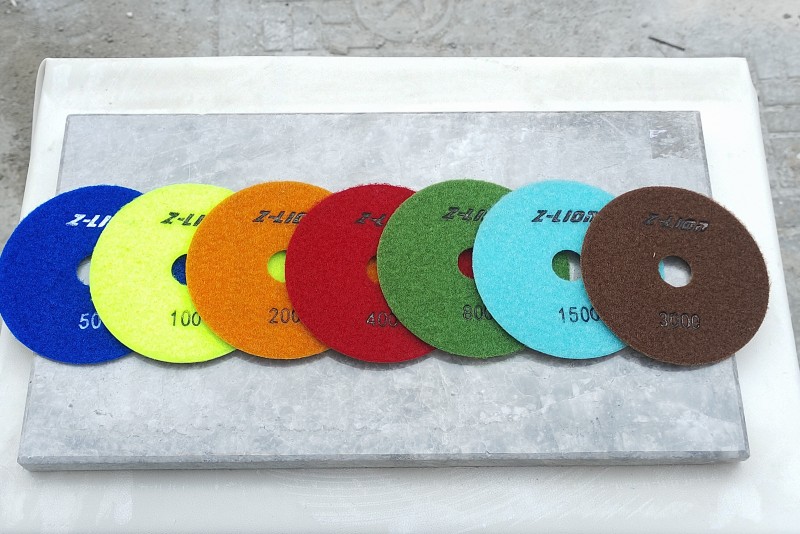
A proper grinding sequence is crucial for achieving optimal results and minimizing costs. A common grinding sequence involves using sandpaper with grits ranging from 50 to 3000 mesh. This method ensures the stone surface gradually becomes smooth, effectively preparing it for polishing.
Grinding sequence: A typical grinding sequence is as follows: 50#, 100#, 200#, 400#, 800#, 1500#, and 3000#. Each grit size has its specific purpose, progressively refining the surface.
Cost-effectiveness: Through extensive calculations and experimentation, we have determined that this progressive grinding method achieves the optimal balance between efficiency and cost. By following this process, stone processors can obtain high-quality finished products without incurring unnecessary costs.
Orderly “Scratches” During the Grinding Process
The grit number used in the grinding process represents the fineness of the abrasive particles. For example, the abrasive particles in 50-grit sandpaper have a diameter of approximately 270 micrometers. Understanding the relationship between grit size and the final surface finish is crucial.
Abrasive fineness: As grinding progresses, the diameter of the abrasive particles gradually decreases, reaching less than 5 micrometers at the 3000 mesh level. This gradually decreasing particle size allows for the formation of uniform “scratches” at the microscale.
Light reflection: The orderly arrangement of these scratches is crucial for obtaining a smooth surface that effectively reflects light. After fine grinding, the scratch width should be controlled to less than 5 micrometers, laying a good foundation for subsequent polishing processes.
The impact of irregular “scratches”
Improper handling during the scratching process can lead to serious problems with the final stone product. Understanding potential defects is crucial for ensuring quality.
Skip granularity numbering:
Some people might consider skipping certain sandpaper grits, such as jumping directly from 50 to 400 or even 1500. However, this practice will affect the final surface finish. Each sandpaper grit plays a crucial role in the surface finishing process, and skipping certain grits will result in uneven texture and poor light reflection.
Accidental scratches:
Accidental scratches can severely affect the quality of grinding. These scratches can be caused by a variety of reasons, including:
Impurities generated during the grinding wheel production process.
Abrasive particles remaining inside the grinder.
External contaminants, such as sand and dust brought in by conveyor belts or shoe soles.
Other hard particles that may come into contact with the stone surface during the grinding process.
To mitigate these issues, a clean working environment must be maintained, and equipment must be inspected regularly for scratches caused by foreign objects.
The Function of Polishing
Polishing is the final step in stone processing, following grinding. This process uses specific materials to finely treat the stone surface, aiming to enhance its smoothness and gloss. The importance of polishing cannot be overlooked, as it directly affects the final appearance and quality of the stone product. A well-polished surface is not only aesthetically pleasing but also improves the stone’s wear resistance and stain resistance.
Processing after grinding to 1000 mesh
Grinding stone to 1000 grit results in a relatively smooth surface, but it still appears rough at a microscopic level. The abrasive particles of this grit size are approximately 13 micrometers in diameter, meaning that polishing with only 1000 grit abrasive will only achieve a surface gloss level of about 15.
To enhance the gloss and smoothness of stone surfaces, crystallizing powder can be used. This powder works through several mechanisms:
Etching with acidic substances: The acidic components in the crystalline powder help etch the surface, smoothing out scratches left by 1000# abrasive.
Resin filler: The resin in the crystalline powder fills tiny defects on the stone surface, making the surface smoother.
Microrheological abrasive action: Abrasive particles in the crystalline powder provide a micro-abrasive action, further polishing the surface.
By using crystallizing powder after grinding to 1000#, the stone can achieve nanoscale smoothness, thereby significantly improving its gloss and overall appearance.
Post-grinding treatment to 3000 mesh
When stone is ground to a finer 3000 grit, the surface becomes smoother, and the diameter of the abrasive particles decreases to below 5 micrometers. At this point, the etching effect of the crystallizing agent weakens, while its filling effect becomes more crucial. Subsequent processing steps after grinding to 3000 grit include:
Sealing and filling: The main goal of this stage is to enhance the filling effect of the filler and sealant. This step is crucial because it improves the visual appearance of the stone surface, which has already achieved a certain smoothness through polishing.
Quality checkpoint: This step serves as a quality checkpoint, ensuring the surface is adequately prepared for the final polishing stage. Using additives and sealants at this stage helps enhance the stone’s appearance, making it more visually appealing.
A properly treated, finely ground surface exhibits a clear color and luster, enhancing the overall elegance of the stone. This refined polishing effect far surpasses simple coarse grinding, ensuring a more perfect visual result after polishing.
Mastering Grinding Techniques and Principles
Grinding is fundamental to any successful stone finishing project. Those who can consistently achieve a mirror-like shine on stone surfaces are generally considered grinding masters. Conversely, those who struggle to maintain the shine may encounter problems during the grinding process. Here are some practical tips to improve your grinding skills:
Cross-grinding technology:
For projects meeting minimum standards, at least three rounds of cross-sanding must be performed using a horizontal brush. For advanced projects, at least five rounds of cross-sanding should be performed on each section. This technique ensures an even, flawless surface finish.
Each time you grind, make sure the width of the previous grind is covered by at least 5-10 cm. This overlap helps eliminate any unevenness and creates a uniform surface.
The order of grinding discs:
It is recommended to use 3 and 5 steps grinding discs, but they must be used in sequence; no grade should be skipped. Each grit size of grinding wheel has its specific role in surface finishing. Skipping a grade will result in uneven surface texture and poor final results.
Remove water and slurry promptly:
During the grinding process, timely removal of water is crucial. Before removing water, ensure the grinding area is clean. After completing each grinding zone, use a vacuum cleaner to remove any residue around the grinding disc and head. This prevents contamination and ensures a cleaner grinding process.
Prevent foreign objects from entering:
Extra care should be taken to prevent sand or other foreign objects from contaminating the sanding area. Protect the sanded floor and restrict unauthorized access to prevent damage. Keeping the work area clean is crucial for achieving high-quality sanding results.
-
Online service
-
Official wechat account

-
QQ:40933769
-
E-mail:sales@z-lion.com
Online Message
Please feel free to give your inquiry in the form below. We will reply you in 24 hours.